Four Airports.
One Valley.
Amongst the most congested airspace in the country.
This page documents how CRE Visual Solutions™ operates legally and mitigates liability, what the $95 coordination fee covers, what federal law does when the process is skipped, and one documented case where the client was subpoenaed. Everything here is citable, and the sources are named where they’re used.
Harry Reid, Nellis AFB, North Las Vegas, Henderson Executive — plus tour helicopters running low over I-15 and Las Vegas Boulevard on final approach to the west apron at Harry Reid. Some of the most constrained airspace in the country.
Authorization, explained.
LAANC — near-instant
For standard flights within the FAA’s published grid altitudes, the Low Altitude Authorization and Notification Capability (LAANC) grants authorization electronically, in near-real time. Most Las Vegas properties clear this way, at no charge.
Manual filing — up to 90 days
Surface-area zones near Harry Reid sit outside LAANC’s reach. Those flights require the FAA’s manual DroneZone process — location research, mission purpose, risk assessment, and written mitigations, reviewed by a person at the FAA — and the review can take up to 90 days. A rejection is adjusted and resubmitted, not abandoned.
The $95, precisely. The FAA Airspace Coordination fee covers the written risk-assessment filing when a manual authorization is required. Most properties clear instantly through LAANC at no charge — the fee applies only when a manual filing is required, and it is always a per-shoot line item, never folded into base pricing.
Proof of Work 1
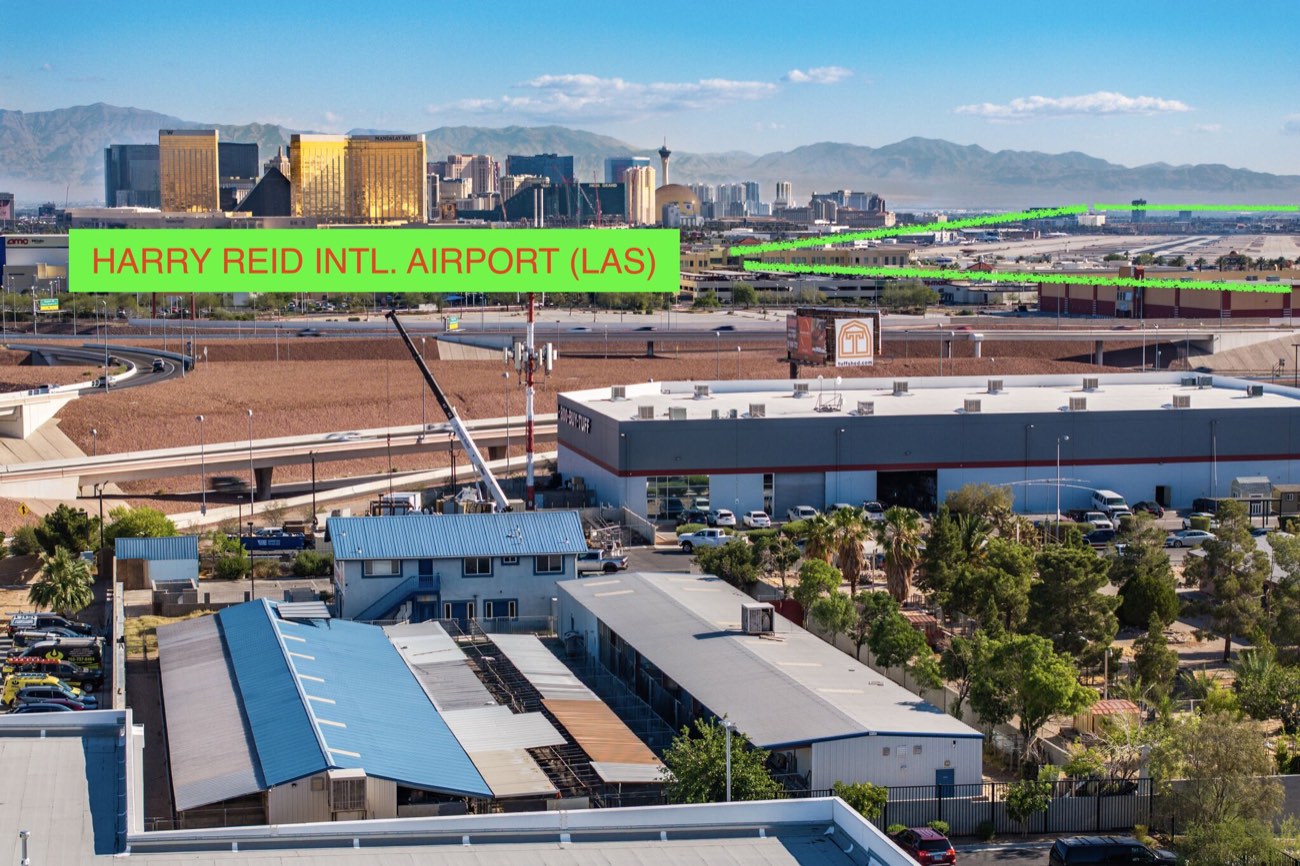
Harry Reid International Airport (LAS), outlined in green, photographed from roughly one nautical mile off runways 1L/1R, inside Class B airspace, under a per-operation FAA authorization obtained for that flight — restricted airspace operations requiring a heightened degree of situational awareness most other vendors don’t possess.
This is what a compliant aerial looks like from the inside: a frame a marketing team can publish and a risk manager can file, backed by a certificate, a registration, and an authorization that match the operation.
Proof of Work 2
This brokerage team video opens with a flight north up Las Vegas Boulevard, past New York-New York and the MGM Grand. The Tropicana corridor carries tour helicopters on final approach into Harry Reid, with hard boundaries near the west apron — restricted airspace operations most operators can’t shoot.
A separate project entirely — flown under its own FAA airspace authorization, coordinated directly with an FAA field officer, by an FAA-licensed drone pilot.
It serves anywhere in the country — the same per-operation authorization work travels to any market a property sits in.
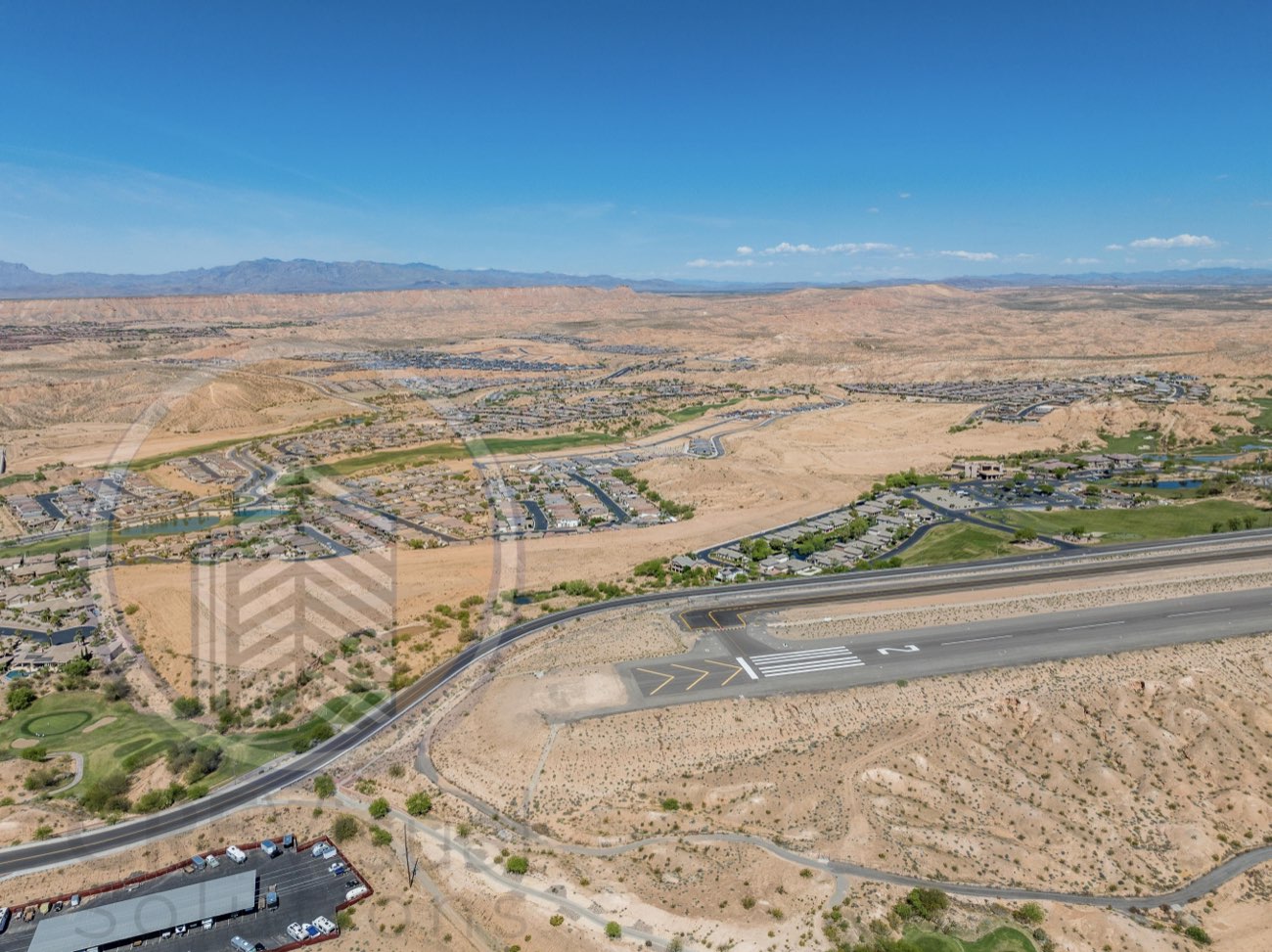
A secondary-market field, the runway in frame — a non-towered airfield, so nothing to file. The airspace check happens before every flight regardless.
Penalties and accountability.
What violations cost.
The FAA Reauthorization Act of 2024 raised the maximum civil penalty for drone violations to $75,000 — assessed per violation.
Flying an unregistered drone carries criminal penalties of up to $250,000 and/or up to three years’ imprisonment (49 U.S.C. § 46306, cited in the FAA’s own registration FAQ). That exposure belongs to the person flying the aircraft — not to the party who hired them.
The burden of verification
Verifying that the pilot is licensed, the aircraft is registered, and the airspace is authorized falls on the hiring party. That is not a special drone rule — it is the general legal doctrine that ignorance of the law excuses no one. Hiring the operator does not outsource the diligence.
The 10-day reporting rule
14 CFR 107.9 requires the remote pilot to report any accident causing serious injury, loss of consciousness, or property damage over $500 to the FAA within 10 days. The duty sits with the remote pilot — one more reason credentials are worth checking before the flight, not after.
SkyPan flew.
Macklowe answered.
On December 12, 2012, Macklowe Properties — a New York real estate development and investment firm — received an FAA administrative subpoena over aerial photography flown at 432 Park Avenue by SkyPan International, an operator flying without FAA authorization. SkyPan settled with the FAA for $200,000 against a proposed $1.9 million penalty — plus $150,000 more if it violated FAA regulations within the following year, and another $150,000 if it failed to comply with the settlement.
One stop.
Four minutes.
At an industrial center west of I-15 — inside Harry Reid’s Class B airspace, off the airport’s east–west runways — an unmarked SUV pulled up mid-operation: two armed federal agents. The verification took about four minutes. Part 107 certificate, aircraft registration, and the FAA authorization for that exact block of airspace, produced on the spot.
This was not a ramp check. It was a security verification of an aircraft operating near the approach path of a major international airport — precisely the scrutiny that airspace should invite. One agent left an email address; CREVS now submits mission documentation — authorization, area, altitude, and time window — ahead of every flight in that airspace.
Read the field report on LinkedIn →
An operator who can’t produce those documents on demand isn’t carrying their own risk — they’re carrying yours.
Everything above is checkable — the regulations by citation, the case by public record, the field report by public post. To verify any of it, or to request the underlying documents, write info@crevisualsolutions.com.